
Find Who Owns a Mississippi Property
Answering who owns a property in Mississippi starts with an address. The county tax roll is the other half of that first step. The assessor's entry links that address to a tax-roll owner and a local parcel key. From there, a Chancery Clerk index points to the recorded deed or other instrument. A map helps place the land. Each source does a different job. No single Mississippi deed search spans every county. So you can search Mississippi property records by county once you know which one holds the parcel. Begin with the address, then confirm with the deed.
- Locate the county, then search its assessor land roll by street, owner, parcel, or subdivision, depending on the fields offered.
- Copy the displayed owner name, mailing and site addresses, parcel number, and any deed book/page or legal description.
- Use that name and parcel clue in the county Chancery Clerk's grantor, grantee, or matched-name index.
- Read the latest conveyance and compare its parties and legal description with the assessor entry.
Remember, this approach yields a recorded owner clue, not a title opinion. When the latest deed names an estate, trust, or company, search that exact entity and read the instrument itself. For a fuller present-owner check, see the Mississippi current-owner page.
Mississippi Assessor Records Name an Owner
County land rolls are the practical first stop. With an address in hand, a roll may list the owner name, tax mailing address, site address, parcel number or PPIN, and legal description. It may also show land and improvement values, classification, tax status, and a source or revision date. Exact fields vary by county. The statewide DOR county-services page points toward local offices. It offers no single uniform search form for every Mississippi parcel.
One local route appears in the Madison County owner search. It looks up an owner in the land roll. Treat its result as the assessor's tax-roll entry, then compare it against a recorded instrument.
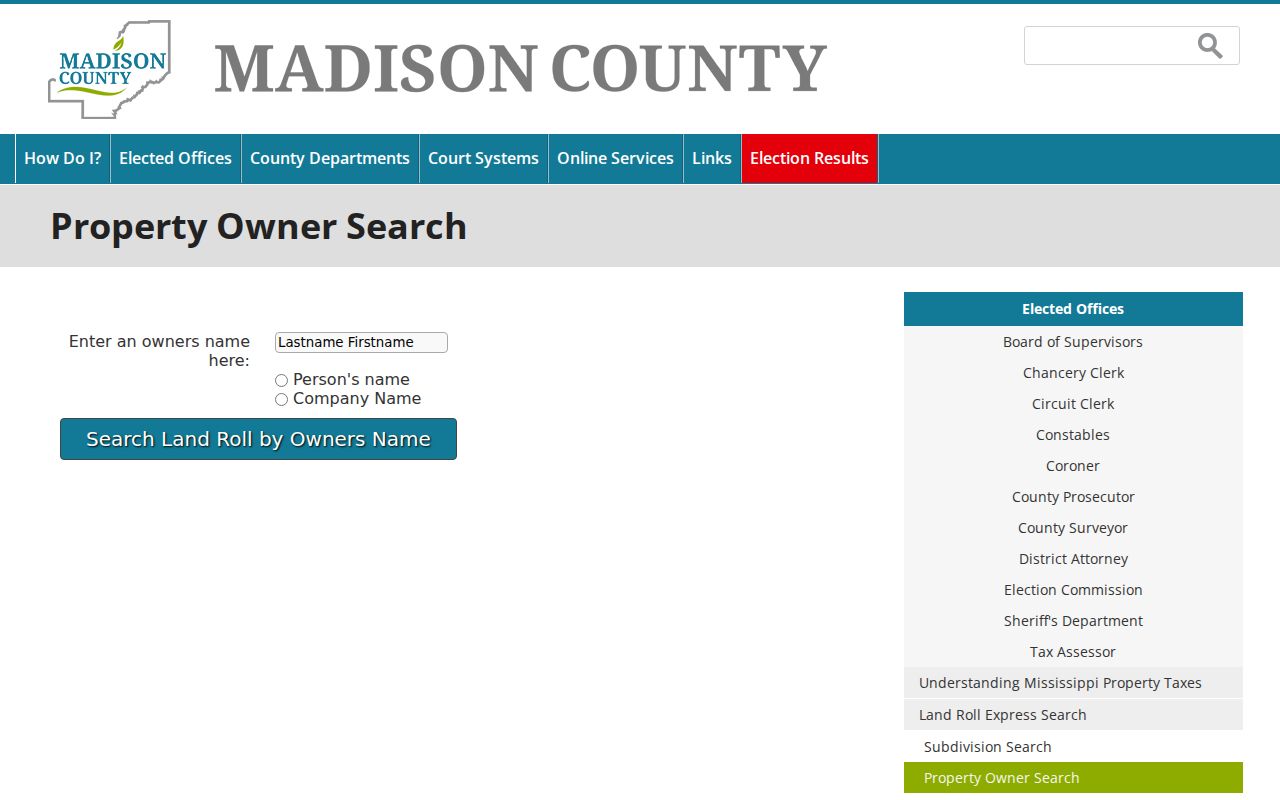
The image shows an owner-search interface from one county. Its labels, roll years, and result details are local choices, not statewide standards.
Mississippi Sources Show Different Owner Facts
One name can surface in several public systems, yet each answers a different question. The roll serves tax administration. The clerk preserves recorded land instruments. A GIS layer helps locate a parcel. The Tax Collector reports billing or payment status. Never copy a name from one source into another role without checking the source record.
| Mississippi source | What the owner search adds | Best use |
|---|---|---|
| County Tax Assessor land roll | Tax-roll name, parcel key, site and mailing address | Start with an address or parcel |
| County Chancery Clerk index | Grantor, grantee, instrument type, and recording reference | Find the recorded transfer |
| County or statewide GIS | Parcel shape and mapped identifiers; attributes vary | Place a candidate parcel |
| County Tax Collector | Bill, receipt, delinquency, or tax-sale handoff | Check tax status separately |
The Mississippi MDEQ Viewer provides statewide map layers, and county viewers may add more local parcel detail. Still, neither a map popup nor a tax receipt is the recorded deed.
Mississippi Property Mailing and Situs Addresses
A situs address names the parcel's physical location. The mailing address tells where tax notices go. Mississippi parcel data keeps these as separate fields, because an owner may receive mail elsewhere, use an agent's address, or hold land through an estate or company. A mismatch is a clue to check, not proof that two records describe different land.
Alongside both addresses, compare the parcel number, PPIN, legal description, subdivision, lot and block, or section-township-range. Rural land and older instruments may carry no useful street number. Postal cities can cross municipal boundaries, and a ZIP label never decides which county keeps the deed. When an address search runs weak, carry the assessor's exact legal description into the clerk's index.
- Owner of record
- The name shown in an official ownership-related record; the assessor's name is a tax-roll entry.
- Grantee
- The party receiving an interest in a recorded instrument.
- Situs address
- The location label for the parcel, distinct from its tax mailing address.
Confirm a Mississippi Property Owner in Deeds
Mississippi land records live with the Chancery Clerk in each county. A county portal may allow searches by grantor, grantee, matched name, instrument number, book and page, parcel, PPIN, street, subdivision, or legal description. The available controls and online years vary widely. The Madison County Official Records portal, for instance, has name and property fields. It is one county's index only.
When a web result stays unclear, call or email the county clerk. You can also visit the correct courthouse or judicial district, or mail a written request for an existing record. Ask whether the target year is indexed online and whether an image is informational or certified. Mississippi's Public Records Act allows actual search, review, copy, and mailing costs. Advance payment may be requested. Response rules and the custodian's written procedures govern each office, so do not assume a free instant search.
For records not online, describe the parcel and instrument as clearly as possible. Put that detail in a mail or email request. A sweeping request for a person's entire history may fail to identify any existing record. The county can explain inspection hours, image fees, and copy methods. If older books are the missing link, the MDAH county microfilm catalog can help identify a series and roll. Do that before an archive visit.
Mississippi LLC, Trust, and Estate Owners
A deed does not always name a person. The grantee may be an LLC, a corporation, a trustee, an estate, an executor, or an administrator. Search the exact entity name in the deed index. Then open the deed itself to see who signed and in what capacity. The Mississippi Secretary of State's Business Services search can confirm a business name, its status, address, and registered-agent filing. That filing is a business record. It does not prove who beneficially owns the real estate.
Estate transfers take extra care. A will alone never changes recorded title. The Chancery Court file, the probate order, an heirship record, or an executor's deed usually supplies the missing link. Probate access varies by case, and some material stays restricted. Ask the county Chancery Clerk what is open before requesting a file. Even when a probate case sits in another county, search the county where the land lies for the recorded transfer.
When Mississippi Tax-Roll Owners and Deeds Differ
Mississippi property is assessed to the owner of record as of January 1 under the statewide framework. A deed recorded later can name a newer grantee while the land roll still carries the earlier name for its tax cycle. Research does not establish one statewide update lag. Compare the roll year and its source or revision date with the deed's file date instead of treating either screen as a live title certificate.
The inspected examples show why the year matters: Madison's assessor page identifies a 2026 land roll, while Harrison's supplied official land-roll page is for 2024. Those are separate county tools, not a promise that every Mississippi roll uses the same cycle or refresh date. If the records conflict, obtain the deed image or ask the clerk to confirm its recording status, then ask the assessor how a correction or update is handled.
Mississippi Parcel IDs Prevent Owner Mix-Ups
A matching surname does not make a matching parcel. County portals label parcels in different ways. Keys may read PIN, PPIN, parcel number, tax map, book and page, or a legal description. Keep the punctuation and leading zeros exactly as shown. Parcels split, merge, retire, and sometimes get new numbers. An older deed may therefore carry a different key than the current tax roll.
Always use a second clue before tying an owner to a property. Compare the legal description or the subdivision and lot. Section-township-range, the site address, or a related instrument works too. The newest ordinary deed may not explain every transfer. Then look for a corrective deed, probate order, partition, foreclosure, or tax-sale instrument. A county GIS feature helps with orientation. But its polygon is only a tax-mapping layer. It cannot settle a boundary or title question.
Mississippi land records hold more than ordinary deeds. Deeds of trust, releases, easements, plats, and liens appear in the files. Mineral or lease interests appear there too. These documents can change how an ownership record reads without changing the assessor name. So when a result cites a related instrument, follow that reference. Compare its legal description too. Never assume the newest ordinary deed is the only paper tied to the parcel.
Limits on Who Owns a Mississippi Property
A Mississippi owner lookup shows what a source records. It cannot prove who occupies the land. Nor can it reveal every person behind an entity or settle title. The assessor roll, deed index, map, and collector receipt each serve a different purpose. Use only the parcel details a property question needs. Respect restricted records and confidential address protections.
Use records with care. Ownership records support property research, civic work, and due diligence. Do not use an address or owner name to stalk, threaten, or harass a person.
Ownership questions often reach further back. The Mississippi former-owner records page follows the recorded chain of deeds backward. Still, the current name is only a starting point, and it must be checked against the instrument and its legal description.