
Mississippi Deed Records Cover More Than Sales
Mississippi land records live with the county Chancery Clerk. Each county decides how much of that index reaches the web. A search usually starts with a grantor or grantee name. From there you match the hit to its legal description and parcel references. Trust it as the right property only then. One recorded deed may prove a transfer. A deed of trust, lien, plat, or release tells another part of the story. The index points you to an instrument. The full document, plus its related filings, supplies the context. Older books may still require a trip to the courthouse or an archive. Many people search Mississippi property records by county this way. They trace one parcel at a time.
| Deed Type | What It Does | Common Use |
|---|---|---|
| Warranty or limited-warranty deed | Conveys an interest under the warranties stated in the instrument. | Sale or transfer between parties. |
| Quitclaim deed | Conveys whatever interest the grantor claims, if any. | Family transfer or title cleanup. |
| Executor’s, administrator’s, or trustee’s deed | Records a conveyance by a fiduciary under the stated authority. | Estate, trust, or court-supervised transfer. |
| Tax-sale or sheriff’s deed | Records a conveyance after a sale process described by the record. | Tax-sale or foreclosure history. |
| Correction or corrective deed | Amends or corrects an earlier instrument reference or description. | Resolving an error in a prior filing. |
Deeds and encumbrances are different record types. Trust instruments, mortgages, assignments, cancellations, releases, liens, leases, easements, covenants, and plats can all appear. They may sit together in the same county portal. A deed of trust secures debt. An assignment may move a lender's interest. A release or cancellation later shows an instrument was discharged. Read the related filings. Do not assume every indexed document marks a new owner of record.
Mississippi Grantor and Grantee Indexes
Direct and reverse indexes sort recorded parties by their role in a transfer. In the DeSoto clerk's guide, direct means grantor and reverse means grantee. The grantor conveys an interest. The grantee receives it. In practice, you start with the current name shown in the land roll. Then follow recorded instruments back through each prior grantor in turn. Treat this as a deed-index method. It is not a replacement for a broad address lookup when you simply need to identify a parcel.
- Search the current owner as grantee and locate the instrument by which that party acquired the land.
- Read the prior grantor, recording date, instrument type, parcel reference, and legal description from the image or index detail.
- Search that grantor as the next grantee. Check name variants and compare the land description at each transfer.
- Repeat until the needed period or an online cutoff is reached, then take the citation to the clerk or archive.
- Grantor
- The party conveying an interest in the instrument.
- Grantee
- The party receiving the interest.
- Chain of title
- The linked sequence of recorded transfers and related title instruments.
- Book and page
- A volume and page citation in a county record book.
- Instrument number
- A county filing identifier; the format and use vary by portal.
Mississippi Deed Records Use Local Fields
The Madison County Official Records portal and the Oktibbeha County DuProcess portal expose a wide set of controls. These cover party, parcel, date, and legal description. Each county configures its own field list. So examples from one portal do not add up to a statewide standard. A Madison form may show an instrument number, book, page, and document type. Its Begin Date default is a user-interface value. That is not proof of records reaching that far back.
When a search returns too many entries, pair a party role with a date range or parcel number. Keep the county's spelling and punctuation. Test likely name variants, but never merge two people just because their names match.
| Portal field or control | Type | Required | Observed format or options |
|---|---|---|---|
| Search All / Grantee / Grantor / Matched Name | Mode | No | Named-party search routes. |
| Full Name | Text | No | lastname, firstname; try spelling variants. |
| Begin Date / End Date | Date | No | Begin date may display 1/1/1800 as a default. |
| Recently Filed | Radio | No | Last 7, 30, or 90 days. |
| Instrument number | Year and number | No | Separate year and instrument number. |
| Volume / Recording Location | Dropdowns | No | County-specific book and location values. |
| Instrument Type | Multi-select | No | All document types plus county-configured types. |
| Book / Page | Text and option | No | Exact citation or page-and-greater search. |
| Legal Description | Text | No | Free text. |
| Parcel ID / Parcel Number / PPIN / Patent Number | Text | No | Local identifiers. |
| Consideration Value | Minimum and maximum | No | Numeric range. |
| Plat / Subdivision | Dropdown | No | Subdivision lookup. |
| Block / Lot / Section / Township / Range / Square | Text | No | Legal-description parts. |
| Quarter / Quarter-Quarter | Checkboxes | No | NW, NE, SW, SE. |
| Street / Number | Text | No | Address criteria. |
| Clear All / Search Records | Buttons | No | Reset criteria or run the search. |
| Append To Existing Results / Export | Controls | No | Combine searches; export Excel, PDF, or XML. |
| Oktibbeha result columns | Selectable fields | No | Grantor, grantee, type, status, pages, legal fields, address, ZIP, parcel, PPIN, and patent number. |
Oktibbeha also offers Search All, Grantee, Grantor, and Matched Name modes, along with date and instrument filters, legal fields, address, parcel, PPIN, and patent number. Its result chooser goes further. Party sequence, cross-party name, workflow and verification status, related items, and legal-description components can all surface there.
Mississippi Deed Records Need the Document
The Madison County search screen provides controls for party names, instrument dates, book and page, legal description, parcel identifiers, subdivision, street, and consideration. Its result detail lists an instrument citation and links to an image or copy option. Save the county and criteria with any result. A later researcher can then reproduce the search. The Madison County Official Records interface shows the recorded-party search workflow. It includes the controls a visitor uses for each deed lookup.
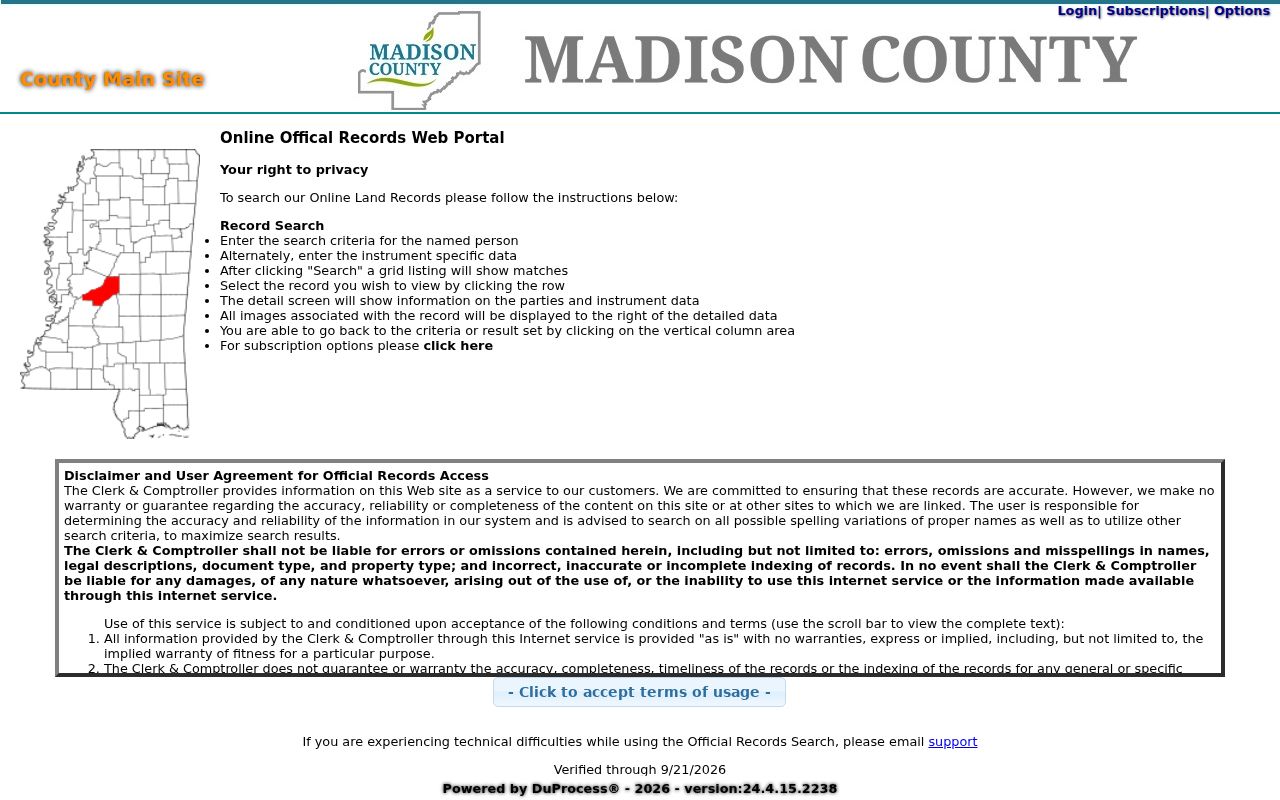
Read the recorded instrument itself before deciding what an index entry means. An image may be free to view, or it may lead to a paid, account-based copy option.
Mississippi Deed Records: Search Result Inventory
Madison and Pike portal detail fields include the citation and document attributes listed here. Treat it as a field inventory, not a populated sample deed. Oktibbeha's selectable result columns overlap but expose their own party sequence, status, and legal-description fields.
| Result group | Fields to preserve | What to verify in the image |
|---|---|---|
| Filing citation | Instrument number, book/page, file date, recording location | That the county, date, and reference match the search. |
| Instrument | Type, page count, workflow or document status | Whether it conveys land, corrects a prior deed, or relates to another filing. |
| Parties | From and To names; filer information | Names, party roles, signatures, and acknowledgments. |
| Property | Parcel ID, parcel number, PPIN, patent number, description | Legal description and tract match. |
| Transaction clues | Consideration, property details, related instruments | Terms and links to releases, corrections, or later instruments. |
| Copy controls | Image/PDF viewer and certified-copy option | Whether the accessible copy is informational or certified. |
Oktibbeha's DuProcess portal also makes its field chooser visible, which lets a user compare result columns without assuming each county publishes the same defaults or that a search result itself certifies ownership. The Oktibbeha portal shows a county-configured DuProcess search and result interface. Its visible controls help explain the terms found in a county deed index.
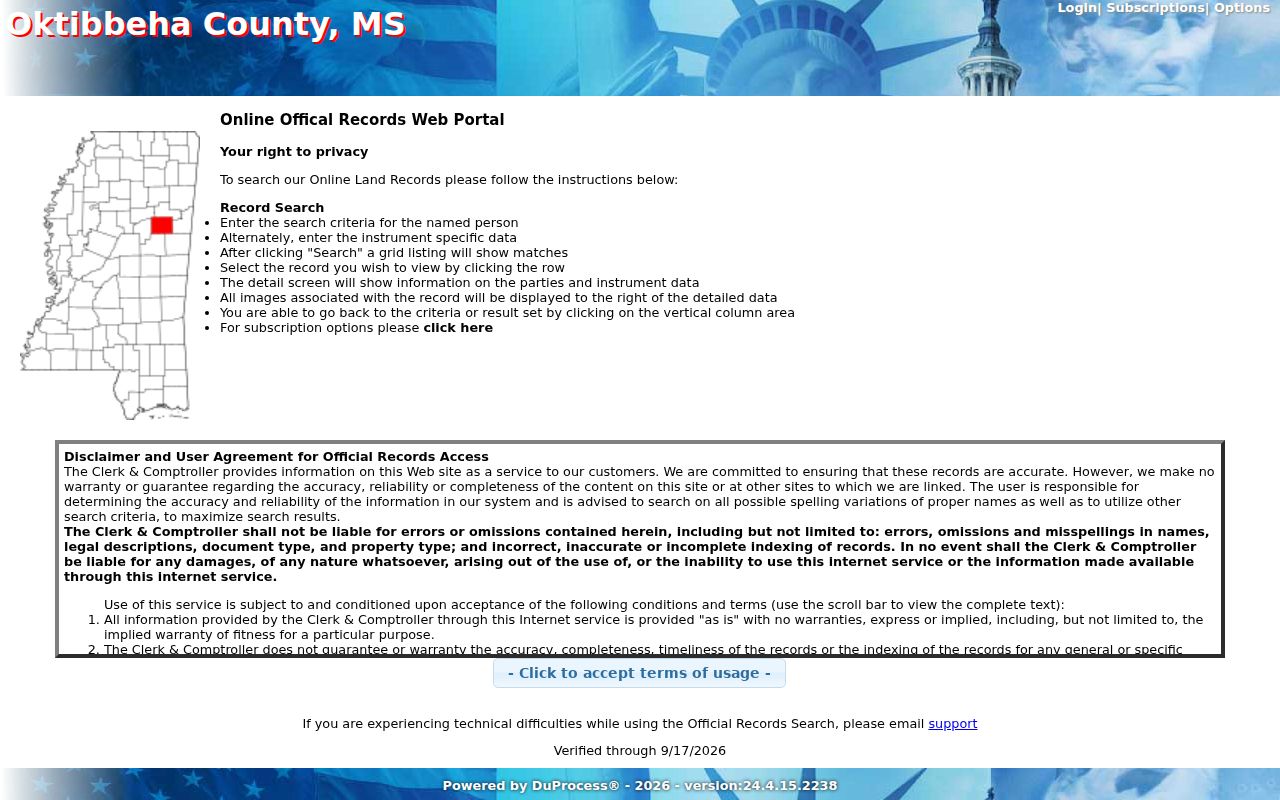
Use the local column chooser to surface legal and party fields where available. Then record your chosen columns along with the search date.
Mississippi Deed Records Have County Cutoffs
DeSoto County is a concrete historic case. Its guide lists warranty-deed image books, direct and reverse, from 1929 to mid-1995. Deed-of-trust images run from 1932 to mid-1995. Power-of-attorney images run from 1934 to mid-1995. Index books and back-scanned deed records are described too. Those cutoffs are DeSoto's alone, not a statewide image range for property records.
The DeSoto Chancery historical index guide shows the county's own terms. Harrison County's virtual index serves historic back-scanned documents by sectional index, book, and page. Harrison labels the historic images informational and sellable online. Current official records carry separate purchase controls. An oldest displayed date, or a portal's default begin date, is never proof the county's whole deed chain is online.
Mississippi Deed Records Move to Books and MDAH
When an online image cuts off, don't assume the deed vanished. Turn to the county book, the sectional index, or a finding aid instead. The MDAH county-records catalog catalogs each county and series. It lists contents, volume, dates, index, judicial district, and roll number. Microfilm is self-serve in the Media Room. Where an exact microfilm copy exists, MDAH asks you to use it. Original Series 2050 boxes are pulled in the Archival Reading Room. They come one folder at a time.
Series 2050 holds original records from 47 counties plus county-record microfilm dated 1799 through 2006. Its finding aid and the pre-1920 county inventory point you to the right series and office. Permanent county series for deeds, mortgages, oil and gas leases, land patents, and sectional indexes stay on the 2025 retention schedule.
Record losses also bend a chain of title. MDAH reports that the 1892 Brookhaven fire destroyed Lincoln County's records. A 1932 fire in Jasper County wiped out old county and Board of Supervisors records. A gap may call for later deed references. It may also call for tax rolls, plats, probate files, or neighboring instruments. The 1818–1902 digitized county tax rolls can suggest a period owner or assessed taxpayer. That clue is still not a deed.
Mississippi Deed Records Include More Instruments
A county's dropdown can list far more than simple deeds. Mineral-rights instruments, oil leases, cemetery conveyances, deed-of-trust corrections, heirship affidavits, transfer-on-death instruments, releases, easements, restrictions, and assignments appear in some systems. Subdivision plats appear there too. The list shows what the county's index can hold. It does not promise every type exists in every county. An earlier citation will not always line up. Then look for correction, assignment, cancellation, release, or re-recording entries.
A recorded plat can settle questions about subdivision and lot and block. It can also cover rights-of-way, dedications, restrictions, or easements. Mineral and royalty instruments may govern subsurface rights rather than the surface parcel. Estate papers run from executor's and administrator's deeds to partition deeds and heirship affidavits. They explain parcels that moved without a conventional sale. Always compare the instrument's full legal description to the parcel. An owner name alone is not enough.
Request a Mississippi Certified Deed Copy
Many portals show the index free and charge for images, certified copies, or subscriptions. Madison and Pike display image and certified-copy controls. Harrison's historic images stay informational unless the office itself certifies them. Fees and payment methods differ county to county, so confirm the current schedule first. At a counter, bring grantor and grantee names, an approximate recording date, parcel or PPIN, and subdivision. Also bring the legal description and any book/page or instrument number you know.
Chancery Clerks are the county land-record custodians in Mississippi. A clerk may answer questions by phone or email. Some offer an in-person terminal. A few provide a copy service. Larger counties can run more than one judicial district. Harrison's clerk lists separate land-record phones for Gulfport and Biloxi. DeSoto's historical guide supplies its own clerk contacts. No single statewide desk can pull county filings.
Put the county, office, instrument type, and date range in any written request. Add the parcel or legal description too. Under the Mississippi Public Records Act, fees may cover actual search, review, copying, and mailing cost. Payment can be required in advance. If a filing or transaction needs a certified document, ask the custodian for certification steps. Ask about current fees as well.
Recorded does not mean guaranteed. A deed index identifies a filed instrument; it does not establish that no later correction, lien, court order, unrecorded claim, or competing interest exists. A title conclusion requires review of the relevant chain and related records.
Mississippi Deed Alerts Do Not Prove Title
Some counties run name-based notifications when a matching instrument gets recorded. Harrison County offers a free DuProcess deed and mortgage fraud-alert service. Lamar County has its own land-record alert enrollment. The programs differ county to county, so there is no single statewide alert system. An alert invites a follow-up with the clerk. It blocks nothing and certifies nothing about whether the name match involves the right owner.
The 2026 Deed Fraud Prevention Act, as introduced, proposed a free alert system and procedures for suspicious documents. But an introduced bill is not enacted law. Take current instructions from the local clerk's live alert page. When a name match arrives, open the instrument citation and check the parcel, party role, and legal description before treating the alert as relevant.