
What Mississippi's Current Owner Record Shows
Think of the assessor card as a tax-roll snapshot. It is not a deed abstract. Copy its key fields before you move on. The parcel number and legal description let you match the name to the right piece of land at the Chancery Clerk's office. The statewide parcel schema separates mailing and site addresses and can also carry value and revision fields, though a county interface may show only some of them.
| Owner name | The name entered on the county tax roll |
|---|---|
| Mailing address | Where tax correspondence is sent |
| Site address | The physical parcel location, if recorded |
| Parcel key | Local parcel number, PIN, or PPIN |
| Legal description | Lot, block, subdivision, or survey text when supplied |
| Source or revision date | A clue to the data source and its freshness |
Not every field is a vesting statement. The card reports, it does not decide ownership. Identify the land with the exact parcel key and legal description, then weigh the roll name against the latest recorded conveyance. The Harrison County official land roll illustrates one county's set of owner and search fields.
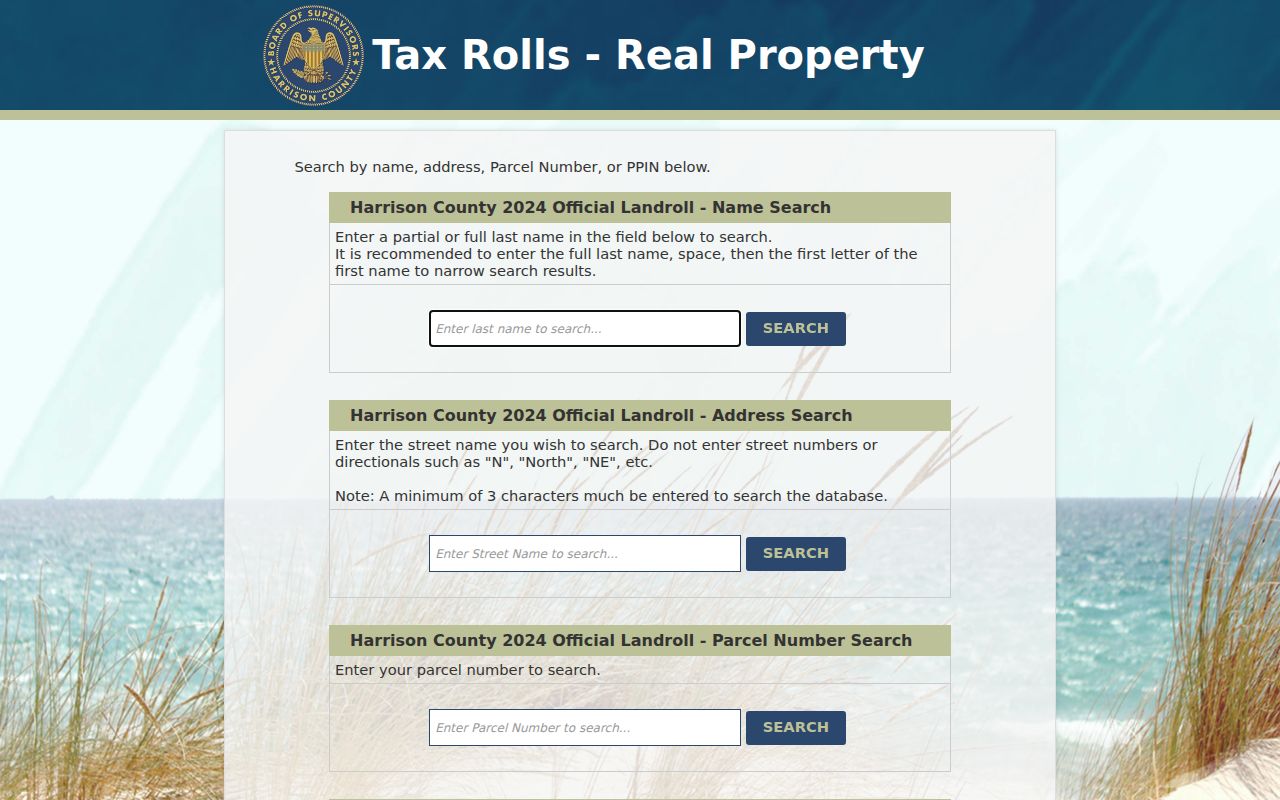
Harrison's screen allows last-name, street, parcel, and PPIN searches. Those are local conventions for that roll, not statewide form rules.
Confirm a Mississippi Current Owner in Deeds
Deed records settle the question. Work in the county where the parcel sits. A Chancery Clerk index may provide grantor, grantee, matched-name, parcel, PPIN, book/page, instrument-number, legal-description, or street searches, though the county portal may expose only some of them. Madison's Official Records portal is one example of the format, not a statewide deed database.
- Search the current roll by the parcel's address or identifier and save the owner name and legal description.
- Search the clerk's index for the displayed owner as grantee, then compare parcel and legal-description fields.
- Open the latest conveyance and read its recording date, parties, instrument type, and property description.
- If the instrument points to an estate, foreclosure, correction, or related deed, follow that reference before deciding what it shows.
A search hit is only an index entry. Read the instrument image itself. Request a certified copy when you need one, and turn to the Mississippi prior-owner chain next if your goal is tracing past transfers.
Why Mississippi Rolls Use a January 1 Owner
Mississippi assesses real property to whoever held title on January 1. Buy a lot in June. The deed goes into the Chancery Clerk's land records right away. The assessor's roll, though, keeps the seller's name through that whole tax cycle. So a careful owner lookup needs both records. Each one answers a different question, and neither tells the full story alone.
That January 1 date marks the assessment point, nothing more. It promises no fixed schedule for online updates. A deed can be recorded months before the next roll appears. Counties post roll years, source dates, or revision dates. No single statewide lag applies everywhere. Check the date a county displays with its data. If the timing stays murky, ask the assessor which roll you are viewing. Ask the clerk whether the newer deed has been indexed. The Mississippi Department of Revenue's local-appraisal guidance lays out how appraisal duties are split. Those duties are divided among the assessor, the collector, and the Chancery Clerk.
Mississippi Current-Owner Roll Years Differ
Never assume a Mississippi county's online roll matches a neighbor's year or schedule. Roll years genuinely differ. Madison's assessor page identifies an approved 2026 roll. Harrison's portal exposes an official 2024 roll. Those examples make the roll year visible. They do not establish any universal refresh cycle for every county.
For another county, start at its official assessor page through the DOR county-services directory. Then check the roll label and any source-date note. A page can mix current parcel attributes with an older tax year. If it offers no freshness field, do not invent one. Contact the assessor and ask what date its owner field reflects.
Freshness can vary within one site. Mixed data is common. A portal can show a new owner name. A deed image may still require a fee or account. Keep the source URL, roll year, and access date with the record. Later you can tell which version you checked.
Mississippi Owner, Mailing, and Site Fields
A name is not an address. Owner fields carry no promise of residence. The mailing line can point to an agent, lender, estate representative, trust, or out-of-county address. The situs field locates the parcel. Treat a mismatch as ordinary and check it against the parcel key and deed description before assuming anyone occupies the property.
- Owner of record
- A name entered on a particular record; the tax-roll version is tied to assessment.
- Vesting
- The way the recorded instrument names the party or parties receiving an interest.
- PPIN or parcel number
- A local cross-reference used to connect a roll entry with a land record.
- Recording lag
- The gap between a recorded transfer and its appearance in another system, which varies by county.
Mississippi data fields can include source-document and revision dates. Keep those dates with the name if the information goes into a property file. A later update can change the roll. A county GIS owner popup may draw from an assessor feed. The map remains a finding aid. For the current owner, prefer the roll's own parcel entry. Compare its name with the recorded deed. If a portal shows a source reference, last-revised date, or deed book and page, save it with the record. That small note later explains why two screens show different names. Neither screen is a live title register.
Mississippi LLC, Trustee, or Estate Ownership
A deed or county tax roll sometimes names an LLC, a corporation, a trustee, or an estate. It may not name a person at all. Search that entity exactly as written. Include punctuation and any former name shown. The Secretary of State's business search confirms filings and a registered agent. It cannot prove who beneficially owns a parcel.
Estates need extra care. A will alone never updates the land record chain. Instead, look for a probate order, heirship determination, executor's deed, or other recorded transfer. It should be filed with the Chancery Clerk. Some probate files carry access limits, so ask the clerk before requesting the case file. A death certificate is separately restricted and is not a deed.
Mississippi Current Owner Access Beyond the Web
Not every county puts its full property records online. Older indexes and images may require a courthouse visit. Call the correct Chancery Clerk through the county's published phone or email, and confirm the proper judicial district when a county has more than one. Bring the parcel number, owner name, approximate deed date, subdivision, and any book/page reference you have.
For any record held by a public body, follow its written request procedure. Ask for an existing roll entry or land instrument. Staff cannot be asked to create a title history. Mississippi's Public Records Act limits charges to actual search, review, duplication, and mailing costs, and an office may request payment in advance.
State law sets response deadlines. Local procedures and record restrictions still matter, though. Request a certified copy when formal certification is needed.
Verify which clerk's office keeps the parcel record before traveling in a county with more than one Chancery district. A phone or email inquiry can confirm the district, image access, and current certified-copy instructions. A mailed request should include the county, parcel key, name, approximate recording date, and any book/page reference. Get an estimate first. Don't authorize big copy jobs without one.
The Mississippi Public Records Act information explains the statewide request and fee framework.
Limits of a Mississippi Current Owner Lookup
The assessor's owner-of-record name is a useful starting point, but it settles little on its own. It cannot prove that no newer deed exists. It also decides no ownership dispute. Check every deed index entry against the instrument itself and its legal description, since a GIS popup, tax receipt, or mailing address cannot prove who occupies a property.
Respect privacy. Mississippi public land records are for lawful property research. Do not use an address or owner name to stalk, threaten, or harass anyone, and avoid republishing sensitive details that are not needed.
For the address-to-owner method, use the Mississippi owner-finding route. Keep the tax-roll name and the recorded deed holder separate.