
Mississippi Property Tax Records by Field
A tax record can be many things at once. It may be an assessment, an exemption, a bill, a payment, or a delinquency that came later. Mississippi divides the work. The Tax Assessor sets the roll. The Tax Collector bills and collects, and the Chancery Clerk keeps the tax-sale and redemption files. Read any result with its tax year, its parcel key, and the office that produced it.
The table below sorts the main questions by record keeper. It avoids folding every number into one statewide balance.
| Tax record area | What it tells you | Responsible record | Where to start |
|---|---|---|---|
| Owner and parcel roll | Name, local parcel key, situs address, classification, roll year. | Tax Assessor | County land roll. |
| Assessed value | Taxable assessed amount, land and improvement values when shown. | Tax Assessor | County appraisal or land-roll page. |
| Homestead and exemptions | Exemption status recorded for the parcel and tax year. | Tax Assessor | Local homestead or exemption record. |
| Bill and payment | Current amount, prior receipt, payment status, tax year. | Tax Collector | County tax inquiry or collector. |
| Delinquency and sale | Unpaid balance, sale notice, tax-sale or redemption event. | Collector and Chancery Clerk | County receipts, sale list, clerk file. |
| State tax lien | Mississippi tax lien enrolled in the state registry. | Department of Revenue | DOR lien registry. |
| Tax-forfeited land | Inventory and later state application or patent information. | Secretary of State | SOS search or tax-forfeited GIS map. |
An assessed value is not a sale price. A payment receipt is not proof of title. The bill may also fold in local millage, special districts, and an exemption outcome that a GIS popup never displays.
Mississippi Property Tax Bill Lookup
Start a county bill search with the parcel number or address from the assessor's roll. The Data Systems Management tax inquiry example takes several search keys. It returns tax-year and property fields. Treat it as one county's configured instance rather than a statewide billing portal. Before relying on an amount or a payment status, check the county and the parcel. These steps keep the assessment and the collection record tied to the same property.
- Find the parcel number or PPIN on the county land roll, and note its county and tax year.
- Open the local collector or tax inquiry and search by parcel; use physical address or name if needed.
- Read the bill year, amount, receipt or status field, and any address or legal-location clue.
- Check the assessor separately for classification and exemption status; do not infer those from payment.
- If delinquency or a sale is indicated, check the county notice and Chancery Clerk tax-sale or redemption record.
- Assessed value
- The value after applying the assessment ratio, used in the tax calculation.
- Millage
- The local tax rate applied under the Department of Revenue formula.
- Homestead exemption
- A qualifying exemption applied through the county assessor.
- Tax lien
- A recorded or enrolled claim tied to unpaid tax; check status and release separately.
The screen's search choices and result labels are listed by field. A live county screen may change over time. The field list does not mean every Mississippi collector uses that vendor.
| Portal field or result | Input or returned data | Use and limit |
|---|---|---|
| Name | Name / Last Name First | Try the format shown by the system. |
| Parcel number | Text | Use the local parcel key. |
| Section / Township / Range | Legal-location fields | Useful for rural tracts where an address is weak. |
| Physical address | Street number, street name, city | Physical location; compare it to the roll. |
| Search / Clear | Run or reset the inquiry | Clear stale criteria before another search. |
| Owner and parcel | Property owner, parcel | Identify the return’s party and local key. |
| Tax and location | Tax year, address, city, county, state, ZIP | Confirm the jurisdiction and billing year. |
| Legal location and status | Section, township, range, AR Tax Status | Check the displayed status with the county collector. |
A result can carry the property owner, parcel, tax year, address, city, county, state, ZIP, section, township, range, and AR Tax Status. The portal's label settles nothing about title. When ownership is the real question, request the clerk-held record.
The Data Systems Management page offers name, parcel, section-township-range, and physical-address search routes. Its search form is a county portal example, not a statewide tax record.
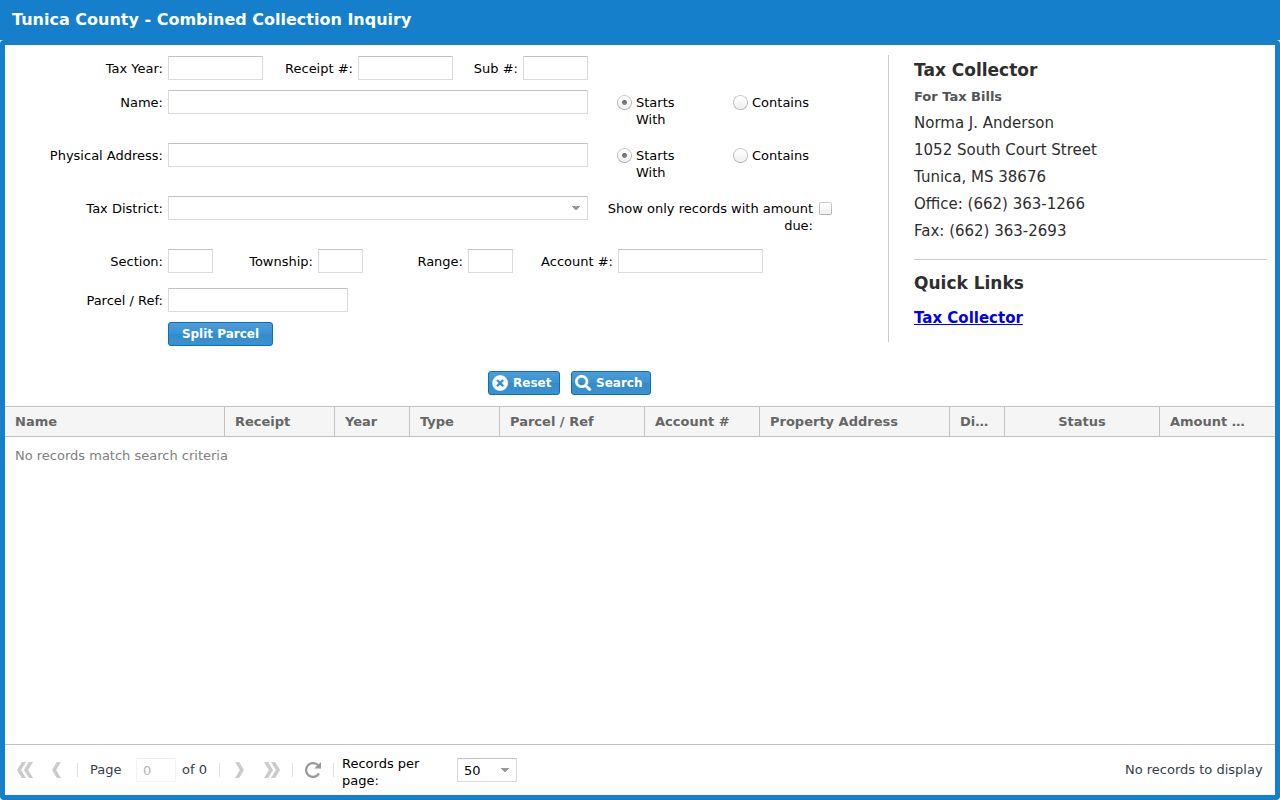
Use the county and tax year in a result. That separates a local bill inquiry from the assessor's assessment roll.
Appealing a Mississippi Property Tax Assessment
DOR directs a taxpayer who disputes a county assessment to the Board of Supervisors route through the county appeal process, with the Chancery Clerk involved in the filing framework. The normal deadline is the first Monday in August before the due date. Confirm the local notice, filing place, evidence rules, and current calendar with the assessor or clerk, because the statewide description is not a parcel-specific notice.
Useful records can include the assessment notice, tax-year land and improvement values, parcel description, exemption status, and comparable public assessment material. A recorded sale or plat can add context, but the assessment appeal is an administrative tax question. Keep a copy of the filed appeal and any decision with the year and parcel key.
Appeal deadline. Mississippi’s general deadline is the first Monday in August preceding the tax due date. Confirm the exact filing instructions with the county assessor and Board of Supervisors before the local deadline.
Mississippi Property Tax Uses Value and Ratio
The Department of Revenue describes the formula as true value multiplied by an assessment ratio. The result is then applied to local millage. The ratio is a statutory assessment level. It does not mean the parcel would sell for only that fraction of its worth. Class I owner-occupied single-family residential property carries a 10 percent ratio. Class II other real property carries 15 percent. The local bill can add districts and exemptions. So keep the assessor's value, the assessed amount, and the collector's bill distinct in your notes.
DOR requires real-property revaluation at least every four years. It also runs a state update process that close-inspects about one quarter of property each year. That schedule does not mean county websites refresh nightly or change in step. Madison's inspected land-roll page identifies an approved 2026 roll. Harrison's identifies an official 2024 roll. Record the local roll year rather than borrowing another county's date.
The DOR property-tax questions and answers cover ratios, millage, appeals, payment dates, and tax-sale steps. A deed's sale consideration field is another clue. It can be blank, nominal, or formatted differently by county. Compare it with the assessment record instead of swapping one figure for the other.
Mississippi Property Tax Bills Follow a Calendar
Mississippi taxes are assessed to the owner of record as of January 1. Bills are generally issued in November and December and due February 1 of the following year, moving to the next Monday when the date falls on a weekend or holiday. The tax-roll owner may therefore differ from a later deed grantee. A newly recorded conveyance and the tax bill are separate records with different timing.
The Tax Collector handles billing and payment; the assessor maintains the land roll; the Chancery Clerk keeps county tax-sale and redemption records. A county site may place these tools on different pages or use different vendors. Use the county site’s current link and save the tax year, parcel number, and receipt or bill reference with the result.
For the address-to-parcel step, the Mississippi property search page describes how to carry a county parcel key from the assessor roll into other records.
Mississippi Property Tax Homestead Filing Window
Homestead exemption applications go to the county Tax Assessor between January 1 and April 1. DOR instructions tie eligibility to owning and occupying a primary residence on January 1. A new deed can trigger a fresh application or county review. So can a change in use or occupancy. Marriage, divorce, death, or disability can have the same effect. The exemption shapes the tax calculation only. It never alters the recorded deed or the parcel's full market evidence.
The DOR homestead exemption page lists application steps, statutory tiers, and disallowance triggers. State rules shift over time. Confirm current instructions with the local assessor, and keep the filing date plus any notice. A third-party tax inquiry that omits the exemption proves nothing about whether it exists.
- Assessed value
- The value after applying the assessment ratio, used in the tax calculation.
- Millage
- The local tax rate applied under the Department of Revenue formula.
- Homestead exemption
- A qualifying exemption applied through the county assessor.
- Tax lien
- A recorded or enrolled claim tied to unpaid tax; check status and release separately.
Mississippi Tax Liens Use a Separate Registry
Mississippi changed where tax liens live. Since January 1, 2015, state tax liens are enrolled online in the Department of Revenue's State Tax Lien Registry. They are no longer recorded with Circuit Clerks. DOR states that a state tax lien covers property in Mississippi. It blocks a sale until paid or removed. Start with the DOR lien-registry notice for that state record.
Federal tax liens stay in county land records where they were recorded. Construction liens, judgment liens, easements, and lis pendens each get their own county index entry too. A lien entry marks a claim, not a conveyance. Before treating one as active, look for a release, cancellation, satisfaction, or later court record. If the underlying transfer is in doubt, compare the lien record against the Chancery Clerk's instrument. Then request the recorded copy from the custodian. Tax payment, lien status, and ownership are connected but separate questions.
Mississippi Tax Sales and Redemption Records
Unpaid taxes can push a county toward its annual sale. DOR describes county sales on the first Monday in April or the last Monday in August, depending on the county. Many use the later date. The local notice controls. A sale opens a redemption period after it. The Chancery Clerk keeps the tax-sale and redemption records. Look at the Tax Collector's receipts, the delinquent list, the sale report, and the clerk's file. Do not trust one delinquent label alone.
Property that draws no buyer at the county sale may later enter the separate state tax-forfeited process. The Secretary of State's search returns inventory records and application details, not a clean-title guarantee. Its filters cover county, address, city, ZIP, subdivision, parcel, PPIN, and owner. They also include legal description, market-value range, and section-township-range.
| SOS search or result item | Observed fields and controls | How to read it |
|---|---|---|
| County and address | County multi-select; address lines; city, ZIP, subdivision | County is required; address can use contains or exact matching. |
| Parcel and valuation | Parcel number, PPIN, market-value range | Use local identifiers to cross-check the county record. |
| Owner and legal location | Assessed owner, legal description, section, township, range | Direction fields specify north/south and east/west. |
| Search controls | Search, Clear, Current Auctions, Next | Results display ten properties at a time. |
| Property details | Show Details, Print Property Details | Detail and print views expose more information. |
| Save and application | Save Property, Login, applicant interest, improvements, offer | Login is required to save or apply; an application record is not title. |
SOS detail fields dig further. They may ask about the assessed owner, a former owner or heir's interest, a mortgage holder, occupancy, improvements, acreage, and offer amount. Those application questions describe the state-land process, not a transfer that already closed.
Mississippi Tax-Forfeited GIS Is a Separate Stage
On May 23, 2025, the Secretary of State announced a tax-forfeited inventory GIS map. The map supports searches by county, parcel number, PPIN, or a user-drawn area. It can even show land-representative contacts and active applications before a person applies. The SOS search also offers a ten-row result display with detail and print views. These tools come after the county process. They do not replace the local collector's receipts. Nor do they substitute for the clerk's redemption file or a later patent.
The state land program runs its own course after default and sale. That course includes a two-year redemption period before forfeiture to the state under applicable rules. Check current SOS instructions before leaning on any deadline. Trace a tax-forfeited listing through its application, patent, and later county recordings. Only then conclude anything about present title. Mississippi's DOR property-tax data adds statewide millage files, contacts, rankings, and tax information. It works well for comparisons. The local roll and bill remain the parcel-level sources.
Request Mississippi Tax Records Offline
A county tax question rarely needs one fixed method. Some counties post tax data online. Others answer at the Assessor or Collector counter, by phone, or by email. A narrow written request works too, provided you ask for an existing record by name. That could be a tax year, parcel key, bill, receipt, or payment history. It could also be an exemption record, delinquent list entry, or a sale and redemption instrument. Contact channels and local fees differ county to county. The state directory routes each inquiry to the local office rather than a single statewide tax desk. The Mississippi Public Records Act sets the baseline: counties may charge actual search, review, copying, and mailing costs. Advance payment can be required. Name the record and the jurisdiction. Ask for research or a new analysis and the county will decline.
Older tax history lives elsewhere. The MDAH digitized county tax rolls span 1818 through 1902. Land and personal property are combined before 1841. They are separated after. Treat these rolls as historical property records, not modern tax bills.
A tax entry may point to a transfer. Pull the recorded document from the county land index. A certified copy from the custodian may be required. A receipt only proves payment on a bill, never ownership of the parcel.