
Trace Former Mississippi Property Owners
Tracing a property's past in Mississippi means walking its recorded transfers backward, deed by deed. The county Chancery Clerk keeps that land-record trail. Start with the current assessor roll to pin down the parcel. A legal description, parcel key, and the grantor and grantee names on each deed will carry you further than a street address ever will. Online indexes reach different years depending on the county. So older conveyances may sit in courthouse books or on microfilm instead. Anyone learning to search Mississippi property records by county should expect that mix. Old tax rolls and maps add useful context. But only a recorded conveyance proves who owned what.
| Backward transfer | Transfer date | Grantor to grantee | Instrument and book/page |
|---|---|---|---|
| Latest conveyance | Copy the recording date shown | Grantor named on the current deed to its grantee | Record the instrument type and book/page or number |
| Prior acquisition | Copy the earlier file date | Earlier grantor to the grantee from the latest deed | Carry the legal description and book/page forward |
| Earlier transfer | Copy the next date in the chain | Next grantor to the prior grantee | Check parcel, lot, and related references |
| Older book or archive item | Use the cited volume's date | Parties named in the older index entry | Continue with the clerk or MDAH catalog |
Work the county index for the current grantee first. When the portal runs out, move to courthouse books or the MDAH catalog. Any table you build is a record-keeping pattern, not a roster of actual owners. A historic tax roll or map may add context. But it cannot prove one person held the parcel continuously.
Move Backward in Mississippi's Grantor-Grantee Chain
Most county indexes offer two directions. The direct, or grantor, search finds what a person conveyed; the reverse, or grantee, search finds what a person received, though labels vary by portal. A grantor gives up an interest in the land. A grantee takes it. Start with the latest deed matching the parcel, then treat that deed's grantor as the grantee on the next earlier conveyance, keeping the same legal description in view as the names shift.
- Write down the latest matching instrument's date, book/page or instrument number, grantor, grantee, type, and legal description.
- Search the grantee's name to locate the deed by which that party received the parcel.
- Read the new instrument's grantor and search that name as the prior grantee.
- Repeat while checking lot, block, section, parcel, and related-instrument references for a true match.
- At the online cutoff, carry the last citation to the clerk or MDAH catalog and continue in the cited book or microfilm.
- Grantor and grantee
- The parties named as giver and receiver of the instrument's interest.
- Chain of title
- The sequence of recorded transfers and related instruments for the parcel.
- Legal description
- The land description used to connect older records when street addresses change.
A name match is only a lead, never a conclusion. Compare the legal description and parcel clues before adding anyone to the ownership sequence.
How Far Back Mississippi Ownership Records Go
Mississippi land records have no single earliest online year. Each county picks its own scan and index history. A web cutoff does not mean older deeds are missing. The next source might be a deed book. It could also be a sectional index arranged by section-township-range, a plat reference, or microfilm. Ask the clerk which series covers your date. Also ask whether the book or image can be viewed.
The Harrison County historic virtual index shows one route. It offers back-scanned instruments reachable through a sectional index, book, and page. Treat historic images as informational. When you need a certified copy, use the county's official land-record process instead.
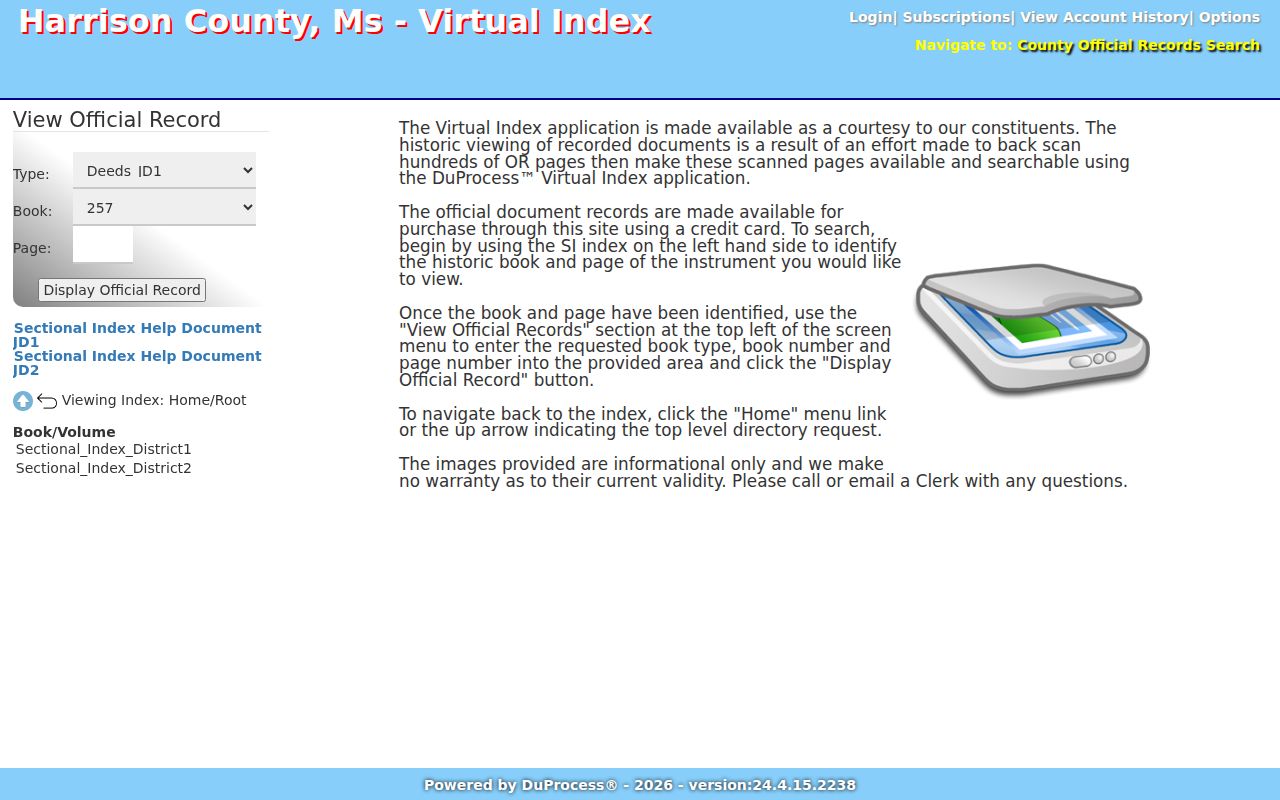
That virtual index is a handy local example of the book-and-page route into older Mississippi instruments. It sets no common cutoff for any other county, though.
Mississippi Direct and Reverse Indexes
In the DeSoto land-record guide, direct means grantor and reverse means grantee. The difference matters when a former owner is being traced. One search finds what a person conveyed. The other finds what they received. Other Mississippi portals may label their fields grantor, grantee, matched name, or search all. So read the local field descriptions before choosing a direction.
DeSoto County Land Records documents one example of historical image books. Warranty-deed images begin in 1929. Deed-of-trust images begin in 1932. The direct/reverse historical index reaches to the mid-1990s. Those dates describe DeSoto's system alone. Carry the book, page, instrument number, and parcel description into any earlier paper search. Microfilm search works the same way.
Mississippi Deed-Index Cutoffs Vary by County
A portal's earliest scanned page, its earliest indexed name, and its oldest surviving deed book can be three different dates. Some portals back-scan older volumes. Others start with recent images or show an index entry with no document image behind it. A beginning-date box in a search form is just a control, not proof the county holds records from that year.
For a former-owner search, note exactly what the portal says about its coverage. Then ask the Chancery Clerk whether a separate historical index, deed book, or district-level series covers the gap. Larger counties can have multiple Chancery districts, so the right office may depend on where the land lies.
Find Older Mississippi Deed Books at MDAH
Older deed books rarely sit online. But the Mississippi Department of Archives and History has mapped where many of them live. Its county records on microfilm catalog describes each holding by county, series, contents, volumes, dates, index, district, and roll number. Search by the exact county and record type. Note the series and roll number before you plan a visit or ask the courthouse to pull its original.
For broader coverage, MDAH Series 2050 holds original county records from 47 counties plus courthouse microfilm. These are dated 1799 to 2006 and undated. The courthouse usually keeps the original, according to MDAH, while Jackson holds the microfilm copy. The pre-1920 county inventory narrows a search to a specific office, volume, and judicial district. Microfilm serves well when an exact copy exists. Original boxes are pulled in the reading room one folder at a time.
Call or email the county Chancery Clerk before traveling. Give the book and page, party names, and an approximate date. Confirm the right courthouse district and whether the index or image is open to you. Older volumes can also be requested in person. When a record sits with a public body but is not searchable online, a written request naming the existing book, deed, or plat works. Ask about search and reproduction fees in advance, since payment may be due before copies are prepared.
Probate Can Break a Mississippi Owner Chain
Not every owner of record acquired a parcel through a normal sale. A deceased owner's estate may need a probate order, an heirship determination, executor or administrator authority, a distribution, or a recorded transfer before title updates. A will alone changes nothing in the land records. Search the Chancery Clerk's probate docket or estate index by decedent name, estate number, county, and date range. Then move to the deed records for the parcel itself.
Estate files may be filed under an estate name, the decedent, a representative, or a trust. A power of attorney can show who signed an instrument. But it conveys nothing by itself. Probate files sometimes carry tighter access limits than deeds. Ask the clerk what is public. Also ask whether a certified copy requires a case-party relationship or court permission. A death certificate is a restricted vital record, not a substitute for a deed.
Mississippi Deed Records and Courthouse Fires
Some record gaps have a documented cause. A courthouse fire can destroy a century of deed records overnight. MDAH and National Register material report that a 1932 fire in Jasper County destroyed old records and Board of Supervisors records. Lincoln County's 1892 Brookhaven fire destroyed its county records. These losses explain broken chains.
When a deed book is missing, work sideways. Later deeds often cite the earlier transfer, and assessor tax rolls, probate orders, neighboring parcel deeds, maps, and newspaper notices can fill the gap. MDAH's record inventory can point to a surviving series or microfilm reel. Treat each reconstructed clue as context only. Seek the recorded instrument or court order before trusting any link in the chain.
Mississippi Legal Descriptions Keep Names Matched
Older Mississippi deeds rarely carry a modern street address. Instead they describe a subdivision and lot, a section-township-range, a fractional quarter, metes and bounds, an acreage figure, or a reference to an earlier book and page. Mississippi portals surface these terms because one parcel can be described several ways over time.
Copy the exact legal description from every instrument. Compare it against the next link. Parcels split, merge, or get renumbered. Streets are renamed and addresses change. Search name spellings and initials widely, but never merge two people with the same name unless the parcel description and transfer details fit. Related instruments may explain a correction or a partial conveyance.
Mississippi Tax Rolls Add Past-Owner Clues
MDAH has digitized county tax rolls covering 1818 through 1902, with a separate territorial series from 1802 to 1817. Early rolls name taxpayers before parcel cards existed. The digitized county tax-roll series is a goldmine for house and land history. But a taxpayer entry is not a conveyance. It may not describe today's parcel the same way.
Historic maps add another clue. The MDAH map inventory lets you search by county, date, title, and geographic coverage, and some maps carry handwritten landowner names or early plats. Pair any map or roll entry with the deed chain and keep the source date.
Keep the record roles clear. Tax rolls, maps, and probate clues can explain a past owner, but only the recorded conveyance and related court instruments establish the documented transfer sequence.
Once you have traced backward, stop and verify. Compare the chain's last link with the Mississippi current-owner record to confirm your starting point still matches the parcel's present roll entry.